
The publication of the article Double white dwarf mergers as progenitors of long-period transients in the Journal of High Energy Astrophysics, a journal of major international visibility with an impact factor of 10.5, represents a significant contribution to high-energy astrophysics and to our understanding of the nature of extreme compact objects. Led by Prof. Manuel Malheiro, the work investigates a question that is currently the subject of intense debate: the origin of the so-called long-period transients, radio-emitting sources with unusually long periods whose nature still challenges traditional models.
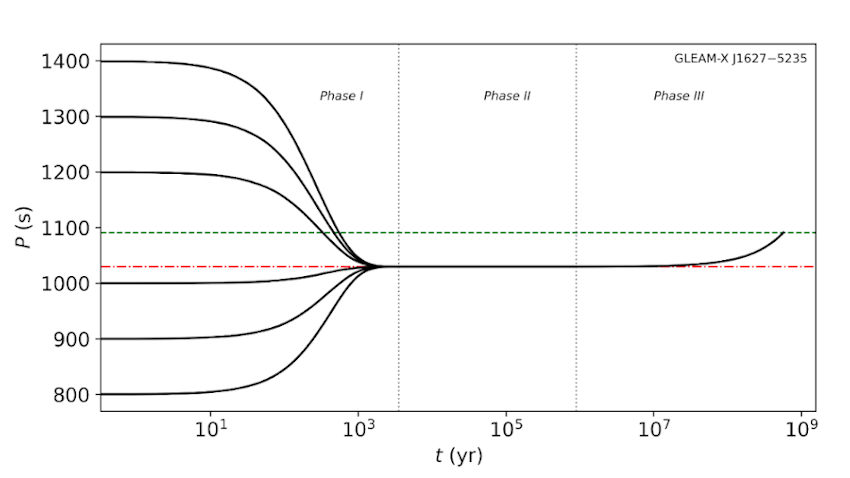
The article proposes that some of these objects may be explained as the product of the merger of two white dwarfs, giving rise to an extremely massive, highly magnetized, and rapidly rotating white dwarf capable of behaving as a “white dwarf pulsar.” In particular, the authors analyze the source GLEAM-X J1627-5235 and show that its properties are consistent with this scenario, combining modeling of post-merger rotational evolution, accretion effects, propeller torque, and magnetic braking. The study derives a rotational age of about 572 million years for this source and shows that this result is consistent with the currently available optical observational limits, thereby strengthening the proposed interpretation.
Beyond its specific interest in a singular astrophysical source, the work broadens our understanding of the possible outcomes of compact binary systems. By suggesting that white dwarf mergers can produce remnants observable as white dwarf pulsars, the article helps redefine the role of these systems in modern astrophysics, going beyond their more familiar association with Type Ia supernovae. The authors also emphasize that future observations, including deep optical observations and studies in the multimessenger context, will be decisive in testing this hypothesis.
The problem addressed in the article is directly related to one of PG-FIS’s research lines, Nuclear Astrophysics, an area that investigates the structure, evolution, and associated phenomena of compact objects such as white dwarfs, neutron stars, and other extreme astrophysical systems. In this context, the work places the Program’s scientific production within frontier questions of physics, bringing together foundations of astrophysics, nuclear physics, and relativity in the study of highly energetic systems that are difficult to interpret observationally.
The publication also highlights a consistent record of training highly qualified human resources within PG-FIS, especially through the participation of several alumni supervised by Prof. Manuel Malheiro: Sarah Villanova Borges (M.Sc., 2018), Jaziel Goulart Coelho (M.Sc., 2009; Ph.D., 2013), Ronaldo Vieira Lobato (M.Sc., 2015; Ph.D., 2019), Edson Otoniel da Silva (Ph.D., 2016), and Khashayar Kianfar (2025).