
Researcher Sílvia Pereira Nunes, an alumna of the Graduate Program in Physics at ITA, recently published two papers in the Journal of High Energy Astrophysics, continuing a research trajectory dedicated to the study of compact objects, especially hot white dwarfs and their astrophysical effects.
Sílvia completed her PhD in Physics at ITA in 2021, within the PG-FIS, with the dissertation Hot White Dwarfs and Their Cooling, supervised by Prof. Manuel Malheiro and co-supervised by Prof. José Domingo Vela Arbañil, from the National University of San Marcos, Peru. Her training in the Program consolidated a line of research at the interface between nuclear physics, relativistic astrophysics, and stellar structure, an area that remains present in her recent scientific production.
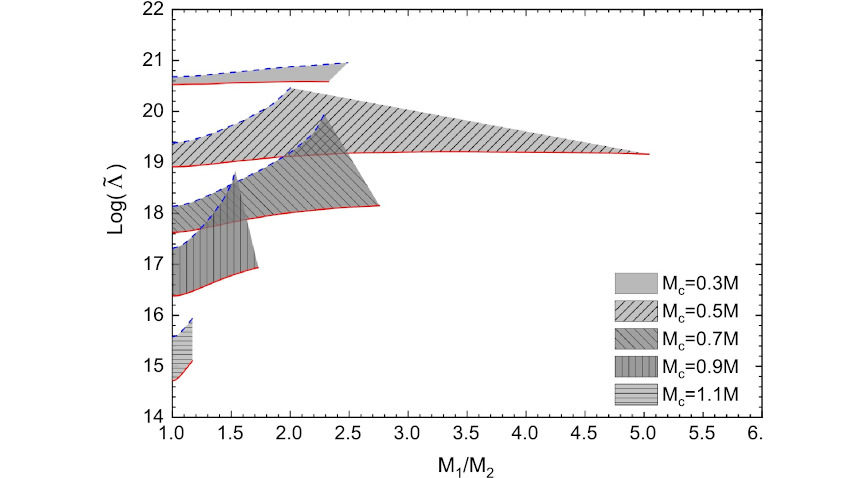
In the paper Exploring temperature influences on gravitational wave production in binary white dwarfs, Sílvia and collaborators investigate how temperature may influence the deformability of hot white dwarfs in binary systems and, consequently, the emission of gravitational waves during merger processes. The study calculates quantities such as the Love number, tidal deformability, and the frequency and amplitude of gravitational waves, with attention to the detection potential of future space missions such as LISA. The results indicate that more massive white dwarfs tend to exhibit lower deformability and may be more favorable candidates for the emission of intense gravitational signals. It is also worth noting that among the coauthors of this work is Prof. César Lenzi, a permanent faculty member of the Program, as well as Prof. Jaziel Coelho, currently a professor at the Federal University of Espírito Santo, who is also a PG-FIS alumnus.
In another work, Dark matter in White Dwarfs: Implications for their structure, the researcher participates in a study on the possible effects of cold dark matter on the structure of hot white dwarfs. The paper proposes a formulation that combines contributions from hot dense plasma and dark matter, evaluating impacts on global properties such as mass and radius. This type of investigation reinforces the role of white dwarfs not only as fundamental objects in stellar evolution, but also as possible astrophysical laboratories for testing properties of matter under extreme regimes.
The papers illustrate the continuity and scientific maturity of a line of research developed from doctoral training at PG-FIS/ITA. By following the production of its alumni, the Program reaffirms its contribution to the training of researchers capable of working on frontier topics in physics, with participation in national and international collaborations.
Sílvia Pereira Nunes is currently a member of the National Nuclear Safety Authority, a strategic institution for the country.