
The Graduate Program in Physics at ITA (PG-FIS) highlights the publication of an article in the journal npj Computational Materials, part of the Nature family with an impact factor of 11.9 (2024), featuring two of its permanent faculty members, Prof. Lara Kühl Teles and Prof. Marcelo Marques.
The recently published study, a scientific collaboration between researchers from the Aeronautics Institute of Technology (ITA) and the University of Antwerp, focuses on precision and efficiency in describing "shallow defect states" in semiconductor materials such as silicon. The study is based on the application of the DFT-1/2 method, developed for the correct prediction of the "band gap," which is the most critical parameter in semiconductors, defining approximately the energy the system absorbs or emits as radiation. Accurate prediction of this energy is vital for the technology industry and for the design of new chips and donor-based quantum technology devices. The DFT-1/2 method stands out for its low computational cost, overcoming the limitations of traditional methods that are often inaccurate or extremely computationally expensive—requiring costly supercomputers—while maintaining high accuracy.
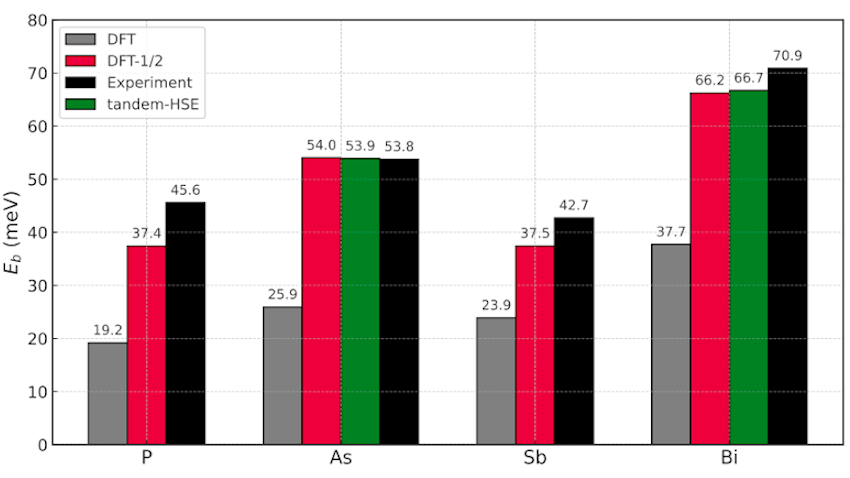
The primary contribution of the article was the development of a specific protocol for shallow defects, which are energy states that are extremely sensitive and difficult to model. The results demonstrated impressive precision, achieving near-perfect agreement with experiments; for instance, in the case of arsenic, the difference was only 0.3 meV. Furthermore, the work proved it possible to include complex effects, such as spin-orbit coupling (SOC) for heavy atoms like bismuth, in systems containing up to 4,000 atoms. This new methodology offers a robust and accessible platform for the scientific community to design advanced materials much more quickly and accurately.
Beyond the relevance of the results, the article also highlights the pioneering role of researchers affiliated with PG-FIS in the development and consolidation of the DFT-1/2 method. The paper itself recognizes this history by relying directly on the foundational articles of the method, authored by the late Luiz Guimarães Ferreira (ITA-ELE 59), alongside Marcelo Marques and Lara K. Teles, who established this approach as an efficient alternative to correct density functional theory limitations in energy gap calculations for semiconductors.
The publication also reinforces the thematic diversity and the educational capacity of PG-FIS. Students interested in Solid State Physics, especially in topics related to the electronic structure of materials, semiconductors, and applied computational methods, find a qualified space for mentorship within the program’s FIS-A (Atomic and Molecular Physics) concentration area.