
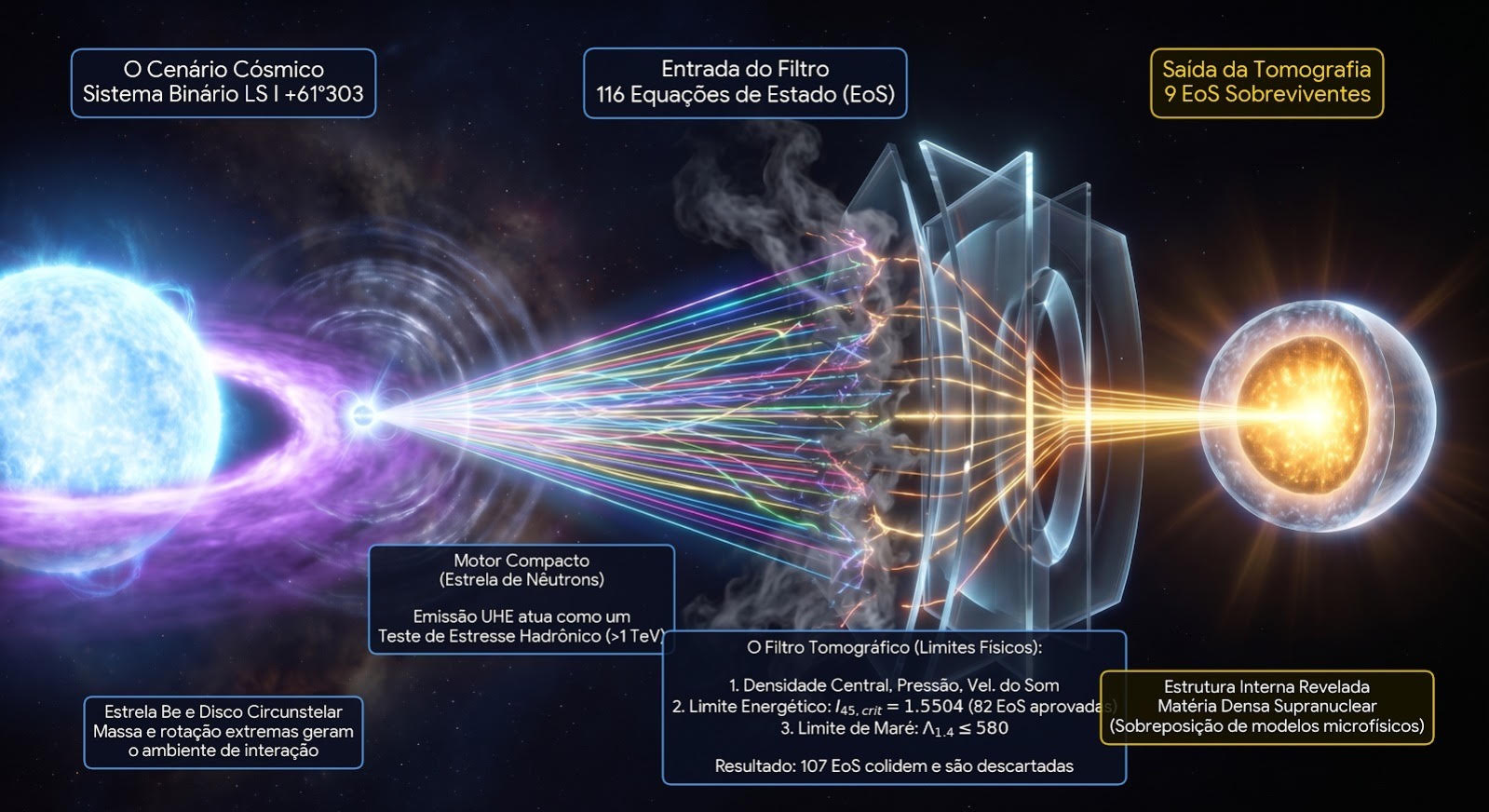
A new study (https://doi.org/10.1103/rlqk-r5xq), carried out by PhD student Marlon Maxuel Souza Mendes under the supervision of Prof. Cesar Lenzi, investigates how very-high-energy radiation (25–100 TeV) emitted by the LSI +61°303 system can help improve our understanding of the structure of extremely dense matter inside compact stars.
The research combines observations from LHAASO (Large High Altitude Air Shower Observatory), an observatory located in China dedicated to the study of very-high-energy gamma rays and cosmic rays, with different equation-of-state (EoS) models, which describe the properties of matter at extreme densities. The results show that the observed emission is energetically compatible with all 116 EoS models analyzed and is therefore not sufficient, on its own, to distinguish among them.
When this information is combined with other constraints, such as the tidal deformability of neutron stars — a measure of how much these extremely dense objects deform under the gravitational influence of a companion body — a smaller number of models remain compatible with the data. These models belong to different microscopic classes, indicating that the observations constrain a region of possible matter structures rather than selecting a single equation of state.
The study therefore highlights the potential of very-high-energy observations, when combined with gravitational waves and other observations of neutron stars, to investigate the nature of matter under extreme conditions that cannot be reproduced in terrestrial laboratories.